Guides → Inversions
Roller coaster inversions explained: loops, rolls and records
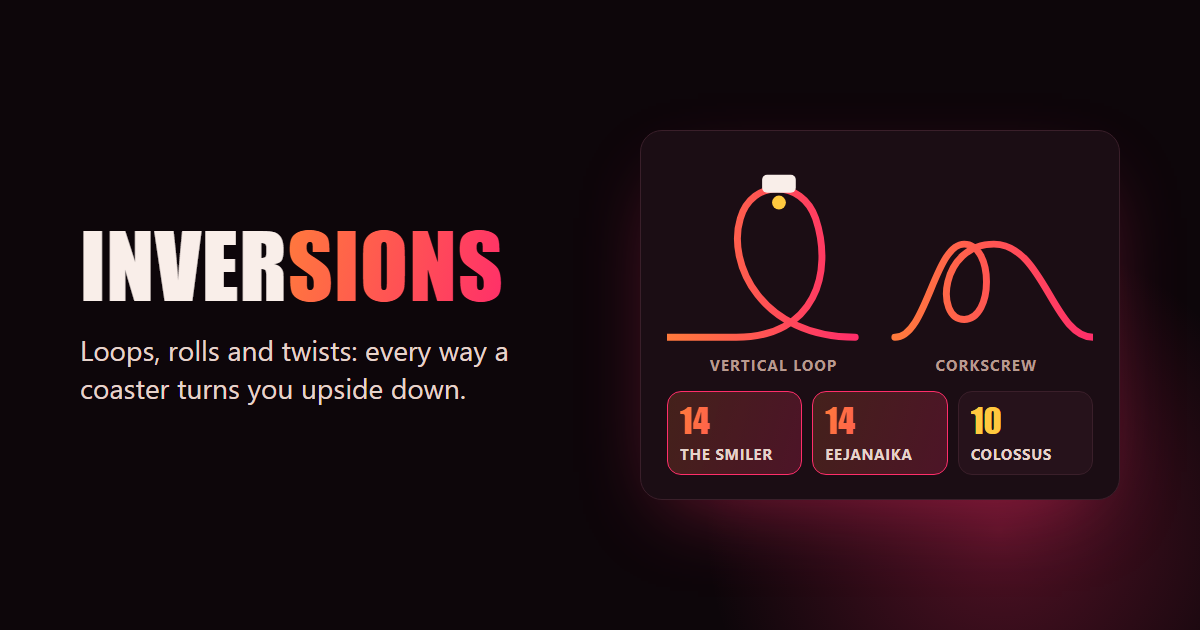
TL;DR: An inversion is any part of a roller coaster that turns riders fully upside down. The main kinds are the vertical loop, the corkscrew, rolls (zero-g and heartline), the Immelmann and dive loop, and two-inversion elements such as the cobra roll. The records belong to The Smiler at Alton Towers and Eejanaika at Fuji-Q Highland with 14 each. More inversions do not always mean a more intense ride, and more than half of the coasters on Achtbaan have none at all.
The inversion count is one of the four numbers on every Achtbaan coaster page, next to height, speed and length. It is also the number that worries first-time riders most. But “7 inversions” tells you little on its own: a gentle roll and a tight vertical loop each count as one, and they feel nothing alike.
This guide explains what counts as an inversion, how each common element works and what it feels like, which coasters in the catalogue turn you upside down most often, and how to ride them comfortably.
What counts as an inversion
An inversion is a section of track that rotates riders beyond sideways until they are fully upside down, then brings them back upright. Coaster databases count each upside-down moment as one, so an element that flips you twice counts as two.
Two things that look similar usually do not count. An overbanked turn tilts the train past 90 degrees but never all the way over, so riders stay mostly upright. And on a 4th dimension coaster such as Eejanaika, the seats rotate on their own axis, so riders can be flipped by the seats rather than the track; those flips are included in its count, which is why it ties for the record.
The inversions, one by one
Vertical loop
The train climbs, turns upside down at the top and comes back down heading the same way it entered. Modern loops are not circles but teardrops (also called clothoid loops): tight at the top and wide at the bottom. A circular loop would need so much entry speed that the forces at the bottom would be uncomfortable; the teardrop lets the train enter more slowly and still make it over the top. At the top of a well-designed loop you are pressed into your seat, so it feels less like hanging upside down than most people expect.
Corkscrew
The track twists through a full 360-degree spiral while the train keeps moving forward, rolling riders upside down along the way. Corkscrews often come in pairs and were among the first modern inversions in the 1970s. They feel fast and disorienting rather than forceful, because the rotation happens quickly and the forces stay moderate.
Zero-g roll and heartline roll
Both rotate the train a full turn around the track. A heartline roll is built so the rotation centres close to the riders’ chests, which keeps sideways forces low and makes it one of the smoothest inversions. A zero-g roll combines the roll with a hill, so you go over the top upside down while feeling close to weightless, the same sensation as floater airtime. Many riders say these are the most fun inversions, and they rarely feel intense.
Immelmann and dive loop
These are half loops combined with a half roll, and they change the train’s direction. An Immelmann, named after an aircraft manoeuvre, goes up into a half loop and rolls out at the top; a dive loop does the reverse, twisting at the top and then diving down through a half loop. Both count as one inversion and are signature elements of large inverted, wing and dive coasters.
Cobra roll and batwing: two at once
A cobra roll is two half loops joined by rolls, shaped like a cobra’s hood. It turns riders upside down twice and sends the train back the way it came. The batwing is a similar double element. These are why a coaster with only a few elements can still list a high inversion count.
Which coasters have the most inversions
From Achtbaan’s catalogue of operating coasters, these turn you upside down most often:
| Coaster | Park | Inversions | Opened |
|---|---|---|---|
| The Smiler | Alton Towers, United Kingdom | 14 | 2013 |
| Eejanaika | Fuji-Q Highland, Japan | 14 | 2006 |
| Colossus | Thorpe Park, United Kingdom | 10 | 2002 |
| Dragon Khan | PortAventura, Spain | 8 | 1995 |
| Helix | Liseberg, Sweden | 7 | 2014 |
| Voltron Nevera | Europa-Park, Germany | 7 | 2024 |
| Takabisha | Fuji-Q Highland, Japan | 7 | 2011 |
| Goudurix | Parc Astérix, France | 7 | 1989 |
Colossus was the first coaster in the world with 10 inversions, and Dragon Khan held the record with 8 when it opened. The Smiler raised it to 14 with a dense, twisting layout. Busch Gardens’ Kumba and Montu also run seven inversions each. Europe is the place to go for a high count: six of the eight rides above are European. To see the whole catalogue in this order, sort the explorer by most inversions.
Do more inversions mean a more intense ride?
Not necessarily. Achtbaan’s thrill score does weigh inversions alongside speed, height and length, because flipping upside down adds disorientation. But the kind of inversion matters as much as the number. Heartline and zero-g rolls are gentle; tight vertical loops and the bottom of a dive loop press you into your seat; a rapid sequence of corkscrews leaves little time to reset. A coaster with three big loops can feel stronger than one with seven quick rolls. Our guide to what makes a roller coaster thrilling explains how to read the mix of stats.
How to ride inversions comfortably
- Head back. Keep your head against the headrest through rolls and twists, especially on older coasters with over-the-shoulder restraints; leaning forward is how heads knock against them.
- Empty your pockets. Anything loose falls out upside down and can hurt someone below. Use the lockers or the bin at the station, and strap glasses on or leave them behind.
- Start smooth. A modern coaster with one loop or a couple of rolls is an easier first step than a ride with a long chain of inversions. Our beginner’s guide suggests rides for each step.
- Check the type, too. Inverted, flying and wing coasters change how inversions feel, because your feet dangle or you lie face down. Our guide to the types of roller coasters explains each one.
Not ready for any of it? You are not limited: 56 of the 101 operating coasters on Achtbaan never turn you upside down, including many of the tallest and fastest rides. Show only coasters with no inversions.
Frequently asked questions
Which roller coaster has the most inversions?
The Smiler at Alton Towers in the UK and Eejanaika at Fuji-Q Highland in Japan share the record with 14 inversions each. Eejanaika’s count includes flips made by its rotating seats; The Smiler’s are all track elements.
Do you feel upside down on a roller coaster loop?
Usually much less than you would think. A loop is taken at enough speed that you stay pressed into your seat at the top, so most riders notice the view flipping rather than hanging in the restraint. Slower, hanging moments come on some rolls and on flying coasters.
Does an overbanked turn count as an inversion?
No. An overbanked turn tilts the train past sideways but not fully upside down, so coaster databases do not count it, even though it can look like one from the ground.