Guides → Your first big coaster
Scared of roller coasters? How to work up to your first big one
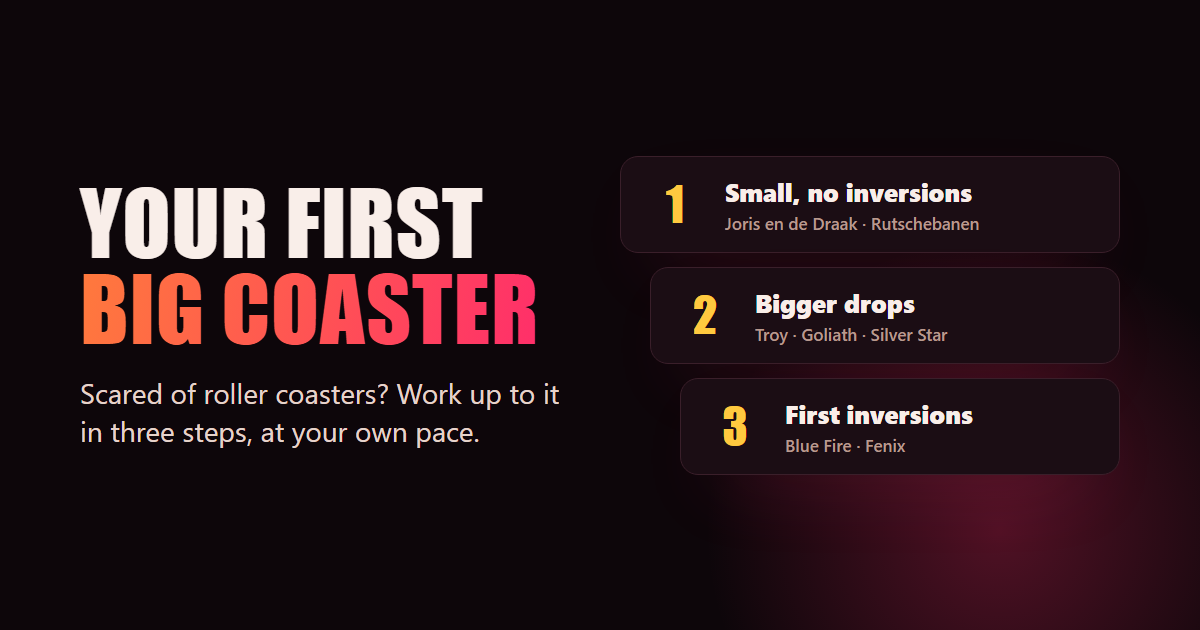
TL;DR: If you are scared of roller coasters, do not start with the biggest ride in the park. Work up in three steps: a small coaster with no inversions, then a taller one with bigger drops but still no inversions, then your first coaster that turns you upside down. Sit in the middle of the train, where the forces are mildest, and check what kind of ride it is, not just how big it is: a dive drop, a launch or a ride in the dark can feel more intense than the numbers suggest.
Being scared of roller coasters is normal, and plenty of enthusiasts started out the same way. The fear usually comes from not knowing what a ride will do. Once you know which parts of a coaster make it feel intense, you can pick rides that add one new sensation at a time, and the big ones stop being a leap into the unknown. This guide explains what to look for, where to sit, and which coasters in Achtbaan’s catalogue make good steps.
What makes a roller coaster feel scary
Most of the fear comes from four moments, and every coaster has a different mix of them:
- The climb and the first drop. A slow lift hill gives you time to think. The first drop is usually the steepest and fastest part of the ride.
- Airtime. The floating or lifting feeling over the top of a hill, the “stomach drop” that many first-timers dread. Our guide to airtime, floater vs ejector explains why some hills float and others throw you up against the restraint.
- Inversions. Loops and rolls that turn you upside down. Loops in particular often feel smoother than people expect, because the forces press you into your seat.
- Launches and surprises. A launch reaches full speed in seconds without warning. Rides in the dark, backwards sections and drops that hold you at the edge play on not knowing what comes next.
The types of roller coasters tell you which of these a ride has: a dive coaster is built around one long held drop, an inverted coaster hangs you below the track, and a launched coaster skips the slow climb.
Step 1: a small coaster with no inversions
Start where nothing turns you upside down and the drops are modest. In the explorer you can show coasters up to 30 metres and 80 km/h; skip the ones on that list with inversions, such as Black Mamba and Nemesis Reborn. Good first rides from it:
- Joris en de Draak at Efteling, a duelling wooden coaster at 25 metres and 75 km/h.
- Rutschebanen at Tivoli Gardens in Copenhagen, running since 1914, at 18 metres and 60 km/h.
- Wicker Man at Alton Towers, a wooden coaster at 22 metres and 70 km/h.
Small numbers do not always mean a gentle ride. Th13teen at Alton Towers is in the same size range but its signature moment is a sudden drop in the dark, and Galactica is a flying coaster that tilts you face-down and turns you upside down twice. Save those for later.
Step 2: bigger drops, still no inversions
Once a small coaster feels fun rather than frightening, go taller while keeping everything the right way up. Troy at Toverland (32 metres) and Wodan Timbur Coaster at Europa-Park (40 metres) are wooden coasters with more speed and more airtime. Goliath at Walibi Holland, at 46 metres and 106 km/h, is a classic next step. When those feel good, the tall hyper coasters Silver Star at Europa-Park and Shambhala at PortAventura are big but built for long, floating hills rather than sharp surprises.
One to treat with care: Baron 1898 at Efteling has no inversions and only 38 metres of height, but it is a dive coaster that holds you over a vertical drop before letting go.
Step 3: your first inversions
For a first coaster that turns you upside down, look for one known for being smooth. Blue Fire at Europa-Park launches you instead of climbing a lift hill and has four inversions, including a heartline roll. Fenix at Toverland is a wing coaster with three inversions, where you sit beside the track with nothing above or below you. Inverted coasters such as Nemesis Reborn score low on size but are known for their intensity, so keep them for when inversions feel familiar.
Where to sit when you are nervous
- The middle usually feels mildest: it is closest to the train’s centre, so the drops and hills are less extreme there.
- The back is pulled over the top of each drop by the cars already going down, so it gets the strongest airtime.
- The front shows you every drop before it happens. Some nervous riders find that seeing what comes next helps; others prefer not to look. At many parks the front row has its own, longer queue.
Small things that help
- Watch it first. See a few trains go round and look at riders’ faces at the exit. Knowing the layout takes away the surprise.
- Sit back. Keep your head against the headrest and hold the handles or the lap bar.
- Breathe out on the drops. Many riders find that shouting or breathing out stops them holding their breath.
- Eat lightly and take breaks between rides, and ride one new coaster at a time.
- Follow the signs at the entrance. Every coaster lists its height limit and health restrictions; they are there for a reason.
Use the thrill score, but check the type
Achtbaan’s thrill score is calculated from a coaster’s speed, height, length and inversions. It is a good way to compare size, and a low score usually means a smaller ride. It does not measure the type of ride, though, which is why Baron 1898 and Nemesis Reborn both score in the twenties. Read the short description on each coaster’s page before you queue.
As you go, mark each coaster as ridden and add the next step to your Want to ride list. Your count grows with every ride; our guide to keeping a coaster count explains how. And if part of your group would rather skip the coasters altogether, our sister site OasePark lists green parks and quiet escapes in Dutch cities for a calmer day out.
Frequently asked questions
What is a good first roller coaster?
Start with a small coaster without inversions, around 30 metres tall or less and no faster than about 80 km/h, such as Joris en de Draak at Efteling or Rutschebanen at Tivoli Gardens. Check what kind of ride it is too: a dive drop, a launch or a ride in the dark can feel more intense than its size suggests.
Where should I sit on a roller coaster if I'm scared?
The middle of the train usually feels mildest. The back row is pulled over the top of drops faster, so it gets the strongest airtime, and the front row shows you every drop before it happens, which some nervous riders like and others do not.
Does a low thrill score mean a roller coaster is gentle?
Not always. Achtbaan’s thrill score is calculated from speed, height, length and inversions. It does not measure the type of ride, so a short dive or inverted coaster can score low and still feel intense.