Guides → Coaster types
Types of roller coasters explained, from hyper to inverted
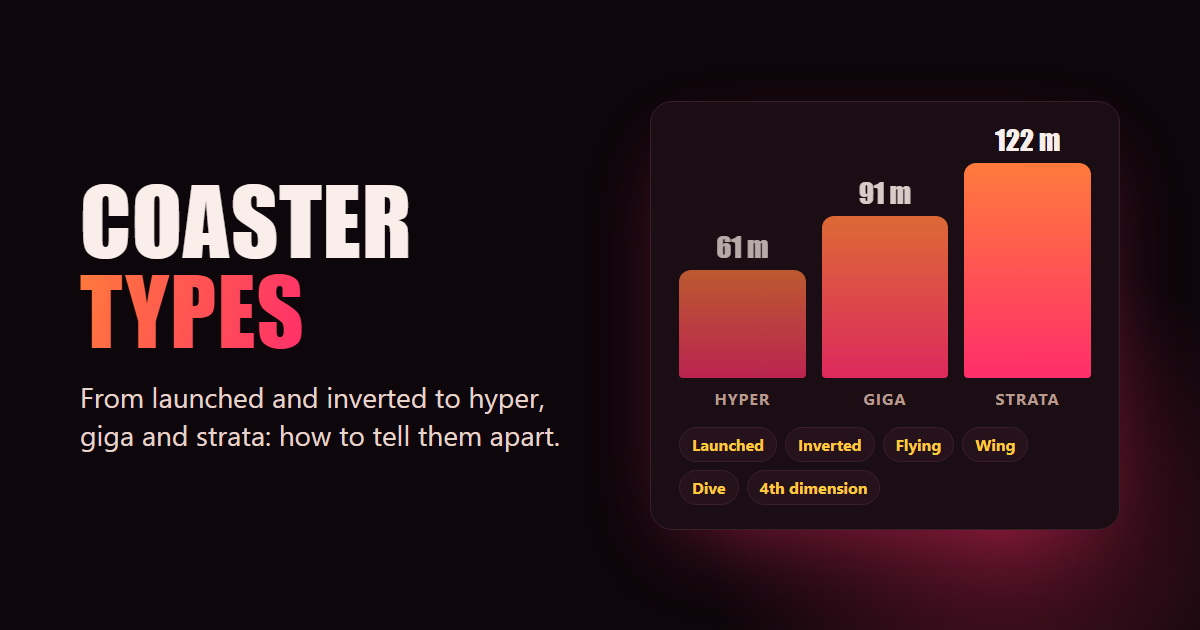
TL;DR: Roller coasters are grouped in three ways. By track: steel, wooden or hybrid. By height: a hyper coaster has a height or drop of at least 61 metres (200 feet), a giga at least 91 metres (300 feet) and a strata at least 122 metres (400 feet). By how you ride: in a car on top of the track, hanging below it on an inverted coaster, face-down on a flying coaster, beside it on a wing coaster, or straight down a vertical drop on a dive coaster. Many coasters belong to several types at once.
Coaster names can sound like a secret language: giga, strata, wing, dive, 4th dimension. Each word describes something real about a ride, and knowing them makes it much easier to pick the coasters you will enjoy most. This guide walks through the main types, with examples you can open in Achtbaan’s catalogue.
By track: steel, wooden and hybrid
The most basic split is what the track is made of. Steel coasters use tubular steel rails and can twist, loop and launch; most record-breaking rides are steel. Wooden coasters run on stacked wooden rails and are known for a rougher, more chaotic ride. Hybrids put a steel running rail on a wooden or steel structure, which lets them combine the look and airtime of a wooden coaster with inversions and steeper drops. Our guide to steel vs wooden vs hybrid roller coasters covers the differences in depth.
By height: hyper, giga and strata
Height classes are named after the tallest point or the longest drop of the ride:
- Hyper coaster: a height or drop of at least 61 metres (200 feet). Hypers are usually built for speed and long airtime hills rather than loops. Examples: Shambhala at PortAventura and Silver Star at Europa-Park.
- Giga coaster: at least 91 metres (300 feet). Millennium Force at Cedar Point opened this class in 2000; Fury 325 at Carowinds is named after its 325-foot height.
- Strata coaster: at least 122 metres (400 feet). Only a handful have ever been built. Top Thrill 2 at Cedar Point, at 130 metres, is the strata coaster in Achtbaan’s catalogue.
Taller does not automatically mean more intense. A tall coaster with gentle hills can feel smoother than a short one packed with sharp drops and inversions, which is why Achtbaan’s thrill score weighs height together with speed, length and inversions.
By how it starts: lift hill or launch
A traditional coaster is pulled up a lift hill by a chain or cable, and gravity does the rest. A launched coaster instead fires the train from a standstill with a hydraulic or electric motor system, often reaching top speed within seconds. Formula Rossa at Ferrari World launches to 240 km/h; Taron at Phantasialand uses two launches through tight rockwork; Red Force at Ferrari Land launches straight up a tower. Some launched coasters, like Top Thrill 2, launch more than once, forwards and backwards.
By how you ride
Inverted coasters
On an inverted coaster the train hangs below the track, with your feet dangling free. Every loop and roll feels more open because there is nothing under you. Black Mamba at Phantasialand and Montu at Busch Gardens Tampa are classic examples.
Flying coasters
A flying coaster tilts riders face-down under the track, so you fly through the layout like Superman. Manta at SeaWorld Orlando and Galactica at Alton Towers ride this way.
Wing coasters
On a wing coaster the seats sit beside the track, two on each side, with nothing above or below you. Near-misses with scenery feel dramatic. Fenix at Toverland is a wing coaster.
Dive coasters
A dive coaster carries wide rows of seats to the top of a near-vertical or vertical drop, holds the train over the edge for a few seconds, then releases it. SheiKra at Busch Gardens Tampa and Baron 1898 at Efteling are dive coasters.
4th dimension and spinning coasters
On a 4th dimension coaster the seats rotate on their own axis as the train moves, so riders flip independently of the track. Eejanaika at Fuji-Q Highland is the best known still running; X2 at Six Flags Magic Mountain, the first of the type, was permanently retired in September 2026. Spinning coasters let the whole car turn freely, so no two rides are the same.
How to use the types when you choose a ride
Most coasters fit several types at once: Top Thrill 2 is a launched strata coaster, Fenix is a wing coaster with a steep first drop. The types tell you what kind of experience to expect. Love weightlessness? Look for hypers and gigas with long hills. Prefer loops and hang time? Try inverted and flying coasters. Want the biggest single moment? A dive coaster’s held drop is hard to beat.
On Achtbaan you can filter the explorer by steel, wooden or hybrid track, and by height, speed and year, then compare up to three coasters side by side. Each coaster page shows its height, speed, length and inversions, so you can see which height class it belongs to at a glance.
Plan a trip around a type
Several of the most famous examples sit far from home for European riders: the giga and strata coasters in the United States, Formula Rossa in Abu Dhabi. Add the rides you want to the Want to ride list, then let the park planner show which park covers the most. Flying out from Amsterdam? Our sister site SchipholParking.info compares parking at Schiphol, so the trip starts without a parking surprise.
Frequently asked questions
What are the main types of roller coasters?
Roller coasters are grouped three ways: by track material (steel, wooden or hybrid), by height (hyper from 200 feet or 61 metres, giga from 300 feet or 91 metres, strata from 400 feet or 122 metres), and by how you ride (sitting, hanging below the track on an inverted coaster, lying face-down on a flying coaster, or sitting beside the track on a wing coaster).
What is the difference between a hyper, giga and strata coaster?
Height. A hyper coaster has a height or drop of at least 200 feet (61 metres), a giga at least 300 feet (91 metres) and a strata at least 400 feet (122 metres).
What is a launched roller coaster?
A launched coaster reaches its speed from a standstill using a hydraulic or electric motor system instead of a chain lift hill. Formula Rossa launches to 240 km/h.
What is an inverted roller coaster?
On an inverted coaster the train hangs below the track, with riders' feet dangling free, so the track runs overhead.