Guides → Airtime
Airtime on roller coasters: floater vs ejector
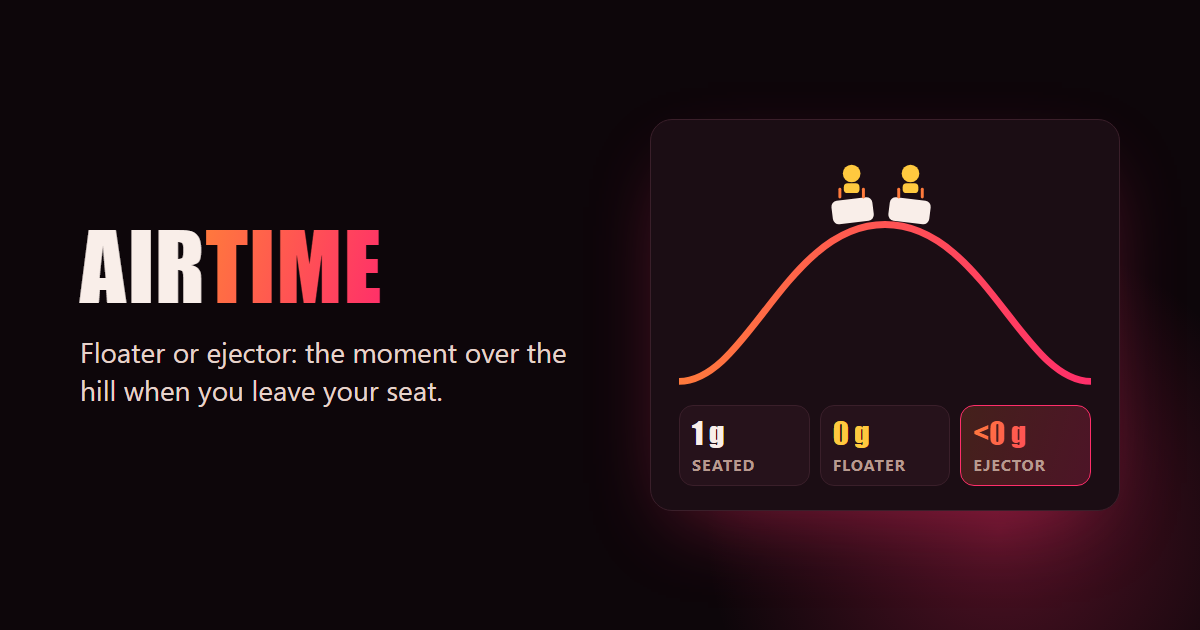
TL;DR: Airtime is the feeling of lifting out of your seat as a coaster crests a hill. Floater airtime is gentle and weightless, close to zero g; ejector airtime is sharper and stronger, below zero g, so the lap bar holds you in. Tall, fast hills with the right shape, hybrids with steel-topped track and classic wooden coasters deliver the most. The thrill score does not measure airtime, so read it alongside the stats.
Ask enthusiasts what makes their favourite coaster special and many will not mention height, speed or loops at all. They will talk about airtime: that moment over the top of a hill when the seat drops away and you float, or are thrown up against the restraint. It is the sensation that makes some modest-looking wooden coasters rank among the most loved rides in the world, and it is the one thing coaster statistics rarely tell you about.
This guide explains what airtime is, the difference between floater and ejector airtime, what makes a ride good at it, and how to find airtime coasters on Achtbaan.
What airtime is
Sitting still, you feel your normal weight: one g. As a train goes over the crest of a hill, the track curves downward underneath you. If it curves away fast enough, the train accelerates downward more quickly than gravity alone would pull you, and you feel lighter. At the right speed and curve you feel weightless; push a little further and you rise off the seat until the restraint stops you. That lift is airtime.
Designers shape hills to control exactly how much of it you get and for how long. A long, rounded hill can hold riders weightless for a few seconds; a sharp, pointed crest delivers a short, hard pop.
Floater vs ejector airtime
Floater airtime
Floater airtime sits close to zero g. You drift up gently and hang there, as if the train has gone quiet beneath you. It tends to come from long, rounded hills and from the first drop of a tall coaster, especially in the back row, where the train pulls you over the top at speed. Many riders find it the more relaxing kind: it feels like flying rather than being thrown.
Ejector airtime
Ejector airtime goes below zero g, so the force pushes you up out of the seat and the lap bar is what keeps you in. It is shorter, sharper and much more intense, and enthusiasts tend to rate it highest. Steep, quickly curving hills, banked turns taken at speed and modern hybrid coasters are where you find it.
Takeaway: floater is weightless and lingering; ejector is forceful and brief. Neither is better; most favourite coasters mix the two.
What makes a coaster good at airtime
- Hill shape and speed. The same hill feels completely different at different speeds, which is why designers profile every crest for the speed the train will carry over it.
- The restraint. A lap bar leaves your upper body free, so you feel every lift. Over-the-shoulder restraints, common on looping coasters, hold you more firmly and mute it.
- Where you sit. The back row is pulled over the top of drops at speed and usually gets the strongest first-drop airtime; the front row sees the track fall away ahead of you.
- Track type. Tall steel hyper and giga coasters use long camelback hills built for floater airtime. Hybrids, which run steel track on a wooden or steel structure, can take sharper, faster hills than a traditional wooden coaster and are known for ejector airtime. Classic wooden coasters deliver rattly, unpredictable airtime of both kinds; our guide to steel vs wooden vs hybrid roller coasters compares the three.
Where to find airtime on Achtbaan
Some well-known examples in the catalogue: Steel Vengeance at Cedar Point and Untamed at Walibi Holland are hybrids famous for ejector airtime; Fury 325 at Carowinds and Expedition GeForce at Holiday Park are tall steel coasters built around big airtime hills; and wooden classics such as The Voyage, Phoenix and Troy mix floater and ejector moments.
To browse more, filter the explorer by hybrid or wooden coasters. Among steel coasters, tall rides with no inversions are usually hypers and gigas built for hills rather than loops.
Why the thrill score does not measure airtime
Achtbaan’s thrill score is built from four statistics that are published for almost every coaster: top speed, height, track length and inversions. There is no equally consistent public figure for airtime, so it is not part of the formula. That is why a wooden coaster with a modest score can still be a better airtime ride than a much taller steel one. Our guide to what makes a roller coaster thrilling explains how to read the mix of stats instead of the maximum.
Plan an airtime trip
Add the rides you want to the Want to ride list on any coaster, then use the park planner to see which trip covers the most of them. Going as a group and arguing over where to stay? Our sister site VoteStay lets everyone vote on the shortlist of places to stay. And when you finally get that back-row seat, follow the ride’s instructions on the restraint: airtime is only fun when you are properly held in.